

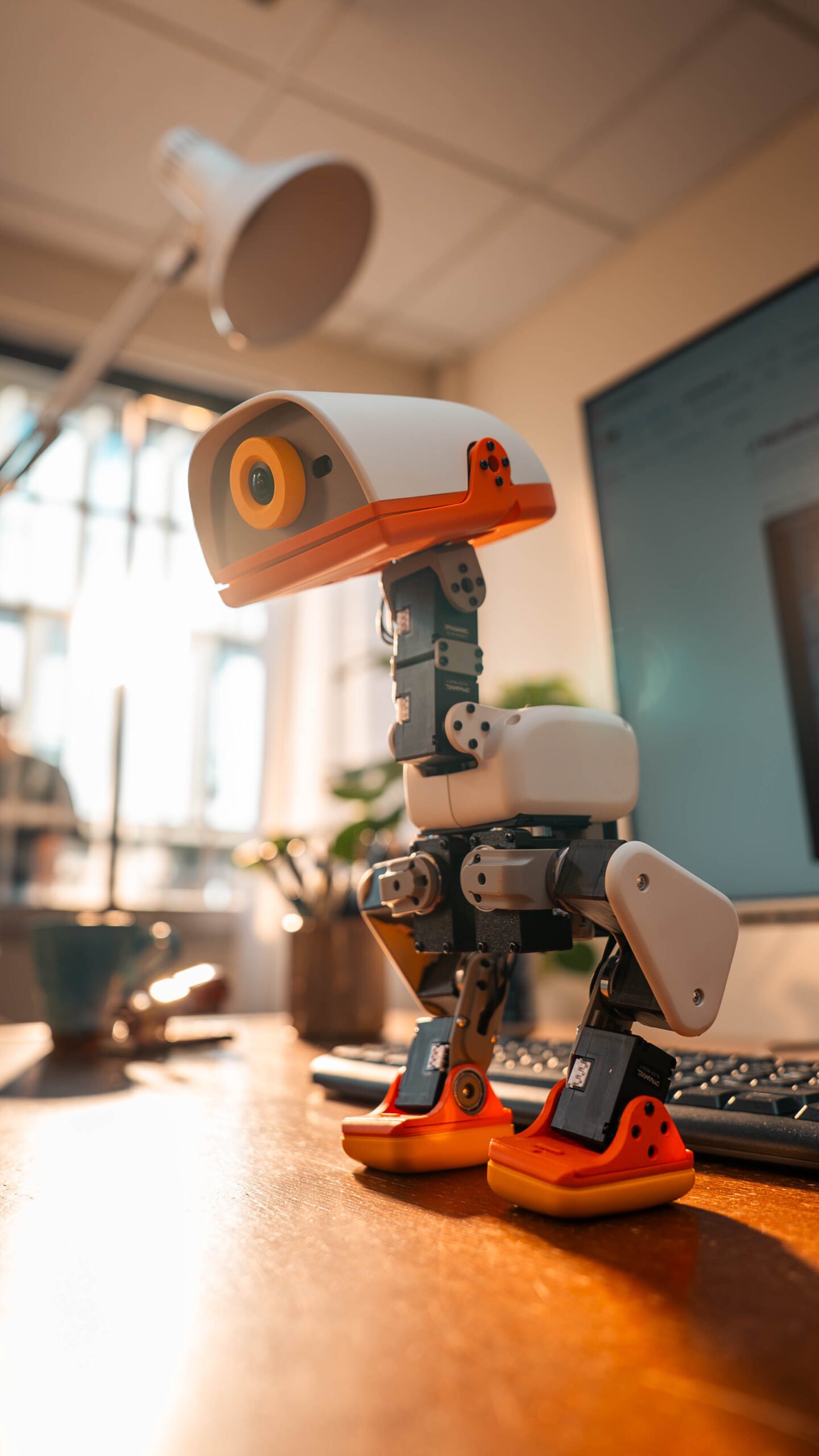
Robotics enthusiasts and AI developers have a new platform to obsess over. Pollen Robotics, part of the Hugging Face ecosystem, has officially unveiled Microduck—a 25-centimeter-tall, fully open-source bipedal robot designed to democratize reinforcement learning. For years, experimenting with advanced bipedal robotics required institutional backing and massive budgets. Now, priced at an accessible $399, Microduck aims to change the paradigm. It isn’t just a remote-controlled desk gadget; it is a sophisticated “sim-to-real” development platform that fits squarely in the palm of your hand.
Punching Above Its Weight Class
Despite weighing just 800 grams, Microduck packs serious hardware. The tiny biped features 15 independent motors, enabling surprisingly fluid, complex articulation. To navigate its physical environment, it has a camera, LiDAR, and two Inertial Measurement Units (IMUs), all governed by a rapid 50 Hz onboard policy loop.
This sensor suite allows Microduck to perform a variety of dynamic movements straight out of the box. Pollen Robotics ships the bot with seven pre-trained behaviors: velocity-tracking walking, sitting and standing, kicking a ball, grabbing objects by dipping its beak, and even roller skating (when equipped with roller attachments). Most impressively, if Microduck takes a tumble, it has an auto-recovery move that lets it get back up from flat on its back, ready for the next command.
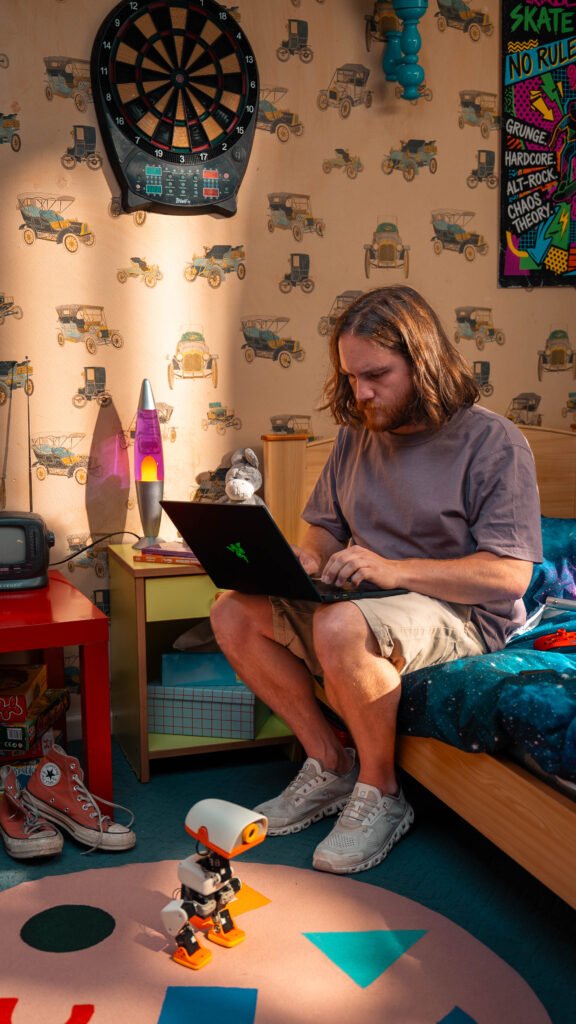
The Magic of Sim-to-Real Learning
While the hardware is impressive for the price, Microduck’s real value proposition lies in its software. Pollen Robotics built the platform entirely around reinforcement learning (RL) and “sim2real” deployment.
Developers can train new behaviors and policies in a MuJoCo physics simulation on their local machines or by utilizing Hugging Face Jobs. Once the virtual Microduck masters a new trick in the simulation, like a complex dance or a new way to navigate obstacles. Developers can deploy that exact policy seamlessly to the physical robot. It represents a streamlined, accessible pipeline for AI builders who want to experiment with physical robotics without fighting proprietary, closed-off systems.
Bipedal Robot is Radically Open Source
Pollen Robotics is leaning hard into the open-source ethos. Pollen Robotics releases the entire Microduck software stack under the permissive Apache-2.0 license. The SDK, the simulation environment, and the complete RL training stack are all hosted on GitHub. This means developers can read, fork, retrain, and share every single line of code that makes the robot tick. The company is actively encouraging a community-driven approach, hoping users will publish their custom policies and share them with the wider flock via Discord.
Pricing and Availability of Microduck Bipedal Robot
Pre-orders for Microduck officially opened on August 27, 2026, with the base robot starting at an introductory price of $399. The base package includes the robot, a battery, a USB-C cable, and a game controller.
For power users, Pollen Robotics is offering several modular add-ons:
- Accessory Pack ($39): Includes a laser pointer, ball, NFC tags, and roller attachments.
- Charger Pack ($39): Adds a dual-slot charger and two extra batteries.
- Dev Pack ($119): Provides spare motors, extra cables, a charger, extra batteries, and Hugging Face compute credits for heavy-duty simulation training.
At $399, Microduck severely undercuts traditional research robots while offering a modern, AI-first software stack. Whether you are a machine learning researcher looking for a low-cost physical testing platform or a maker eager to learn reinforcement learning, Microduck is poised to make a massive splash in the robotics community.
To learn more, check out pollen-robotics.com/microduck.
For more tech news and updates, stick with TGXP3.com.