
Here is the latest tech news on government AI initiatives and online service improvements.
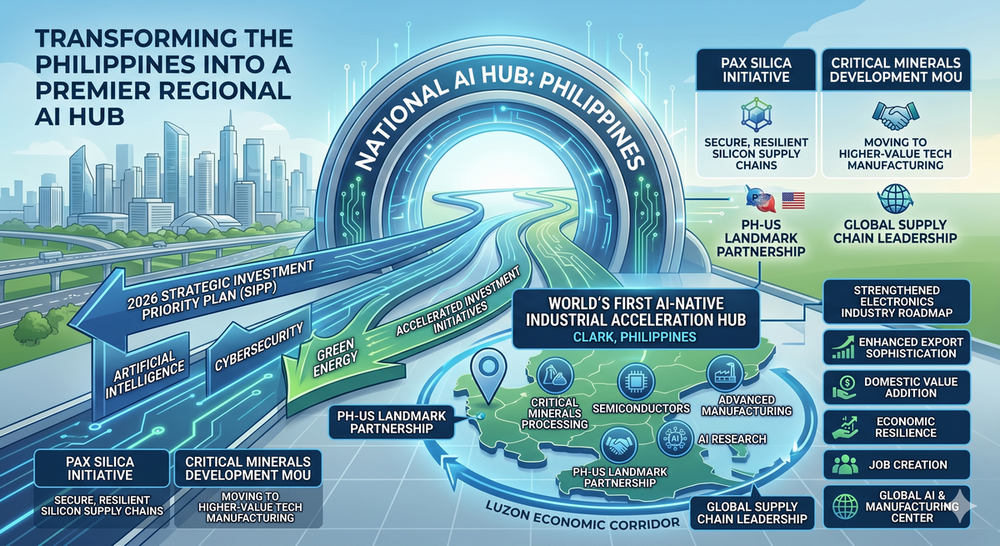
PH as an Emerging AI Hub: The national government has announced accelerated investment initiatives to transform the country into a premier regional AI hub. This aligns with the recently approved 2026 Strategic Investment Priority Plan (SIPP), which heavily prioritizes artificial intelligence, cybersecurity, and green energy. Last April, the Philippines and the United States launched a landmark partnership to establish the world’s first AI-native industrial acceleration hub in Clark, spanning 4,000 acres within the Luzon Economic Corridor.
This future-ready hub will house facilities for critical minerals processing, semiconductors, advanced manufacturing, and artificial intelligence, positioning the Philippines at the forefront of next-generation global supply chains. Anchored by the Pax Silica initiative and supported by a Memorandum of Understanding on Critical Minerals Development, the effort aims to build secure, resilient silicon supply chains and move the country into higher-value technology manufacturing. Philippine officials highlight the hub’s role in strengthening the semiconductor and electronics industry roadmap, enhancing export sophistication, and boosting domestic value addition for mineral resources. With surging mineral exports and rising US foreign direct investment, the initiative is seen as a transformative step toward economic resilience, job creation, and placing the Philippines at the center of the global AI and advanced manufacturing landscape.
Though you may have heard the news about an AI company seeking diplomatic immunity for its sites, which the Philippine government refused (rightly so). Here’s hoping the AI regional hub plan won’t convert nearby areas into polluted, irradiated sites.
EU-PH Digital Initiative: A new joint digital initiative between the European Union and the Philippines has officially launched, focusing on funding massive connectivity upgrades in rural areas while standardizing local cybersecurity frameworks.
The EU-Philippines Digital Economy Package, backed by €20 million from the EU and additional funding from Finland and France, aims to transform the Philippines into a regional digital hub by enhancing bandwidth connectivity, satellite data access, 5G regulatory support, and cybersecurity. Launched through a 2025 partnership formalized between EU and Philippine officials, the initiative supports reliable Copernicus data access for socioeconomic decision-making, upskills local personnel, and strengthens disaster management and climate action through the CopPhil program. The project, part of the EU’s Global Gateway strategy, is jointly implemented by Philippine agencies and European partners to boost smart, secure, and sustainable digital infrastructure and services.

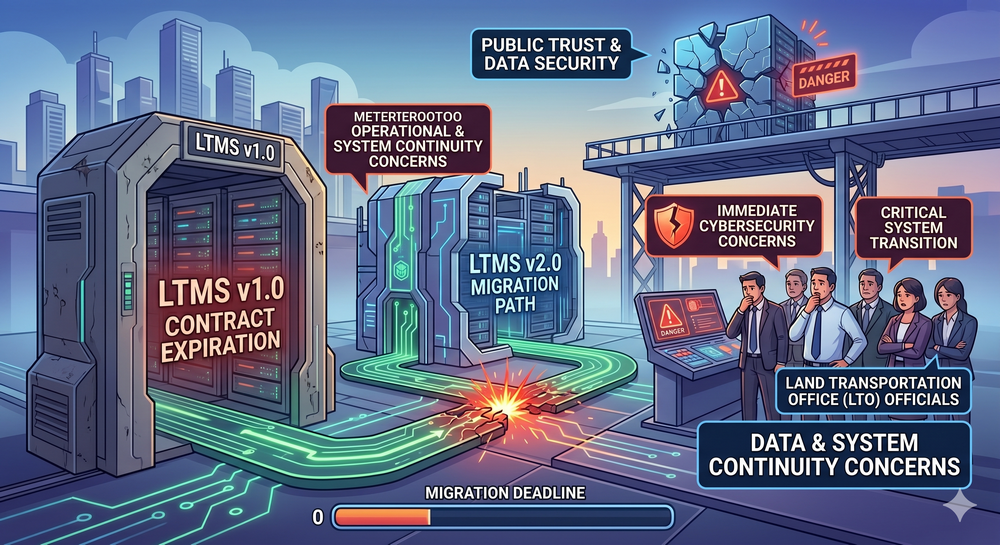
LTO Cybersecurity Alerts: The Land Transportation Office (LTO) has raised immediate cybersecurity and operational concerns regarding the transition of data and system continuity as its current Land Transportation Management System (LTMS) contract nears expiration.
The Land Transportation Office (LTO) has opposed German provider Dermalog’s request for a contract renewal and an additional P2.5-billion budget for the Land Transportation Management System (LTMS), citing persistent system deficiencies and unresolved audit findings after seven years and 13 contract extensions. LTO officials highlighted unresolved cybersecurity issues and risks to millions of driver and vehicle records, which may lead to non-compliance with the Data Privacy Act. According to the same report, the Commission on Audit (COA) has repeatedly flagged the P3.14-billion LTMS for delays and incomplete features, with four consecutive audit memoranda documenting these problems. Key issues include problems with vehicle inspections, lack of system connectivity, and the inability to update ownership records, all of which undermine the LTO’s mandate. The expired Dermalog contract and a suspended P1.2-billion financial claim add further controversy, while COA recommends the LTO set strict timelines and consider sanctions for noncompliance to achieve a fully functional IT system.
Here’s hoping that the LTO issues with their service provider get resolved quickly or that it won’t affect their service further.
For more industry tech news, stay tuned to TGXP3.com