

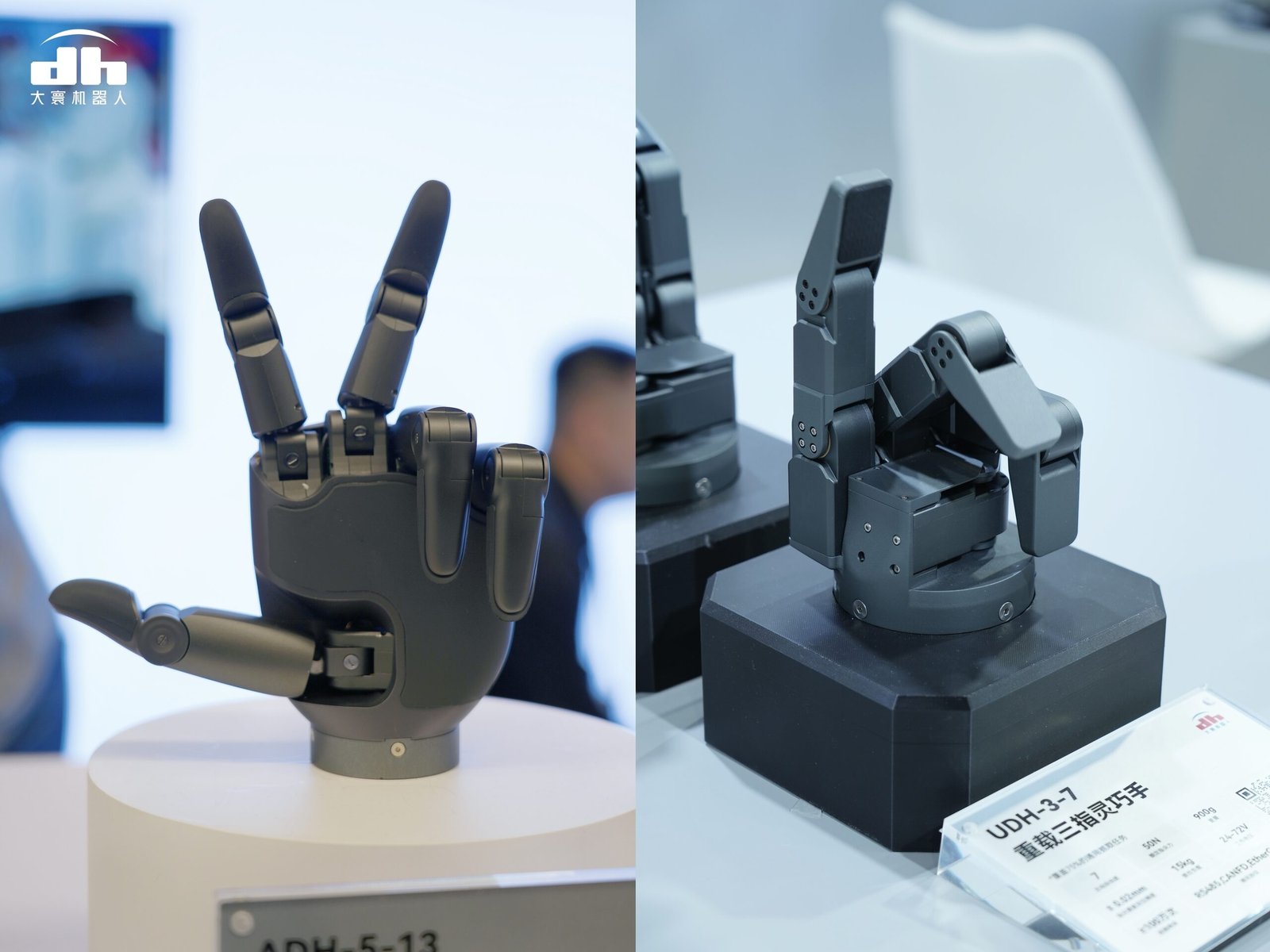
DH-Robotics has rolled out the ADH-5-13, a five-finger robotic hand with 13 independently controlled joints. Alongside it, the company showed off the UDH-3-7, a compact three-finger hand, plus a full lineup of two-, three-, and five-finger end effectors. They’re all designed for different gripping and manipulation needs. This launch shows DH-Robotics’ focus on building robot hands, sensors, and controls that fit the real needs of embodied AI research, teleoperation, and robotics.
ADH-5-13: a five-finger platform for multi-finger manipulation
The ADH-5-13 has five fingers and 13 joints, giving it a human-like range of motion. The thumb, index, and middle fingers each have three joints. Meanwhile, the ring and little fingers have two joints each. The index and middle fingers can also move side to side by 15°. This’ll help the hand take on more complex poses.
Weighing in at 735 grams, the hand aims to offer plenty of dexterity without adding too much weight. Once it grabs an object, it can lift up to 20 kilograms.
The ADH-5-13 comes with fingertip tactile sensors and can be upgraded with options like electronic skin, force sensors, or vision-based touch sensors. If a sensor or module needs replacing, you don’t have to take apart the whole hand or finger. DH-Robotics says this design can make repairs up to three times faster, reducing downtime and costs.
Each of the 13 DOF joints uses a direct-drive system, giving you precise, independent control. Dual magnetic encoders at every joint help the hand know exactly where its fingers are, with repeatability down to 0.2 millimeters. The design also supports both force and position control, letting the hand handle objects gently or firmly as needed.
UDH-3-7: strength, flexibility and a compact three-finger form factor
The UDH-3-7 features a compact three-finger design with seven joints. It can lift up to 15 kilograms, deliver up to 50 newtons of fingertip force, and offers precise positioning down to 0.02 millimeters. DH-Robotics rates it for a million cycles, so it’s built to last.
Like the five-finger model, this hand uses a direct-drive system. Its thumb can rotate a full 180 degrees and move to oppose the fingers, making it easier to grip objects of all shapes and materials. The UDH-3-7 works with CAN FD, RS-485, and EtherCAT, and developers can use C++ or Python to get started. It also integrates with ROS 2, Isaac, and MuJoCo, making it easier for teams to test and add the hand to their AI robots.
Robot hands line
DH-Robotics has organized its lineup of two-, three-, and five-finger robot hands to fit different types of tasks:
- Two-finger end effectors: general-purpose gripping and grasping.
- Three-finger dexterous hands: a balance of strength, dexterity and working space for manipulation.
- Five-finger dexterous hands: coordinated multi-finger manipulation and more complex dexterous tasks.
Why is this significant? This could mean the next generation of robots could use more dexterous manipulators that rival or even exceed the capabilities of the human hand.
To learn more, visit dh-robotics.com/.
For more tech news and updates, stay tuned to TGXP³.