

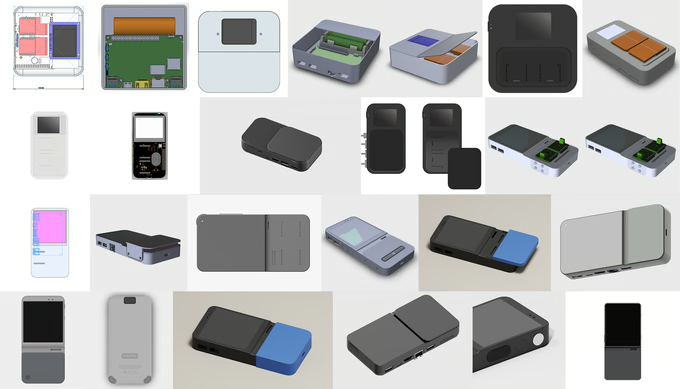
Remember Google’s Project Ara and Phonebook? These were modular mobile phones/pocket computers that let you swap modules, such as the camera, batteries, and storage. While people raved about them and ranted that they didn’t get mass-produced, the concept was too cool to ignore. The idea of being able to swap components on your mobile device was just ahead of its time. But Mecha Systems is trying their hand at it and it could be the one.

Locked-down smartphones and closed ecosystems shouldn’t be the norm, so the Mecha Comet was built. Built by Mecha Systems Inc., this modular Linux handheld just launched on Kickstarter. Early-bird pricing starts at $189, and the campaign quickly beat its funding goal.
At its core, the Mecha Comet is a true Linux computer that fits in your pocket. It has a 3.92-inch AMOLED touchscreen with 1080 x 1240 resolution and runs on NXP Arm-based processors. Buyers can pick the i.MX 8M Plus for efficiency and lower cost, or the i.MX 95 for more power, a Mali GPU, 4K video, and AI acceleration. Both models support up to 8GB of RAM, eMMC storage, microSD cards, and optional NVMe SSDs.
Modularity is the Comet’s standout feature
What truly sets the Comet apart is its modularity. A 40-pin magnetic expansion connector enables modularity.
A 40-pin magnetic connector lets you snap on modules such as a gamepad, a QWERTY keyboard, or a GPIO breakout. The device works with Raspberry Pi HATs and thousands of MikroElektronika Click boards. An M.2 slot supports cellular modems or other PCIe add-ons. This flexibility turns the Comet into a gaming handheld, embedded controller, dev terminal, or portable measurement tool.ibution, the Comet provides access to thousands of software packages while maintaining full open-source transparency. The custom Mechanix Shell, built in Rust with GPU-accelerated Wayland rendering, offers a touch-optimized interface specifically designed for the device’s unique screen ratio.
Mecha Systems focuses on sustainability with easy repairs, standard connectors, and open-source design files under the CERN-OHL-S-2.0 license. This open approach lets the community build and share their own modules.
For developers, makers, and anyone who values digital freedom, the Mecha Comet shows what handheld computing can look like when openness and user control come first.
For more information, visit its Kickstarter page.
Visit TGXP³ for more updates!